
Remembering Davey Lopes: Grit, Greatness, and Rhode Island Pride

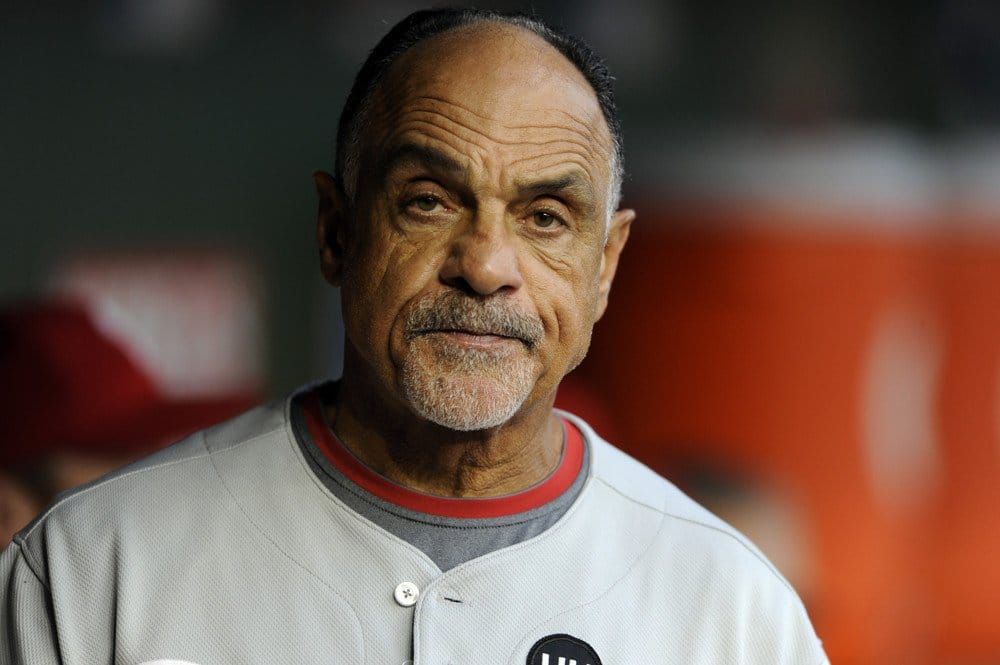
I grew up during a time when it felt like the Yankees and Dodgers met in the World Series every year.
They faced off in 1977, 1978, and 1981. I hated the Yankees, so every October, I became a Dodgers fan.
And I grew to love those Dodgers teams.
It was a great era for baseball personalities. Managers like Earl Weaver, Billy Martin, Whitey Herzog, and Sparky Anderson brought as much intensity to the game as the players. Even now, I could name most of the managers across the league—Gene Mauch, Chuck Tanner, Dallas Green, Don Zimmer, a young Joe Torre.
But the one I loved most was Tommy Lasorda. I remember buying his autobiography, The Artful Dodger. It may have been one of the first books I ever chose to read on my own. It's somewhere on my book shelf right now.
What made those Dodgers teams so memorable wasn’t just Lasorda—it was the infield.
Never before—or since—has an entire infield stayed together that long.
I grew up hearing about Tinkers to Evers to Chance, immortalized in a 1910 poem. They played together for the Chicago Cubs from 1902 to 1912 and were eventually elected to the Hall of Fame, in part because of that legacy.
I never saw them play.
But I did get to watch Ron Cey, Bill Russell—not that Bill Russell, which confused me as a kid—Davey Lopes, and Steve Garvey.
Those four players were together from the time I learned to walk until I reached middle school.
Cey, “The Penguin,” had real power for that era. Russell was steady and reliable at shortstop. Garvey was the star—movie-star looks, smooth swing, always among the league leaders in batting average.
Not the best audio quality, but excellent interview with Ron Cey reflecting on the life of Davey Lopes.
But Davey Lopes was the straw that stirred the drink.
He was the engine of that infield—not just in performance, but in presence. The way he carried himself. The way he played the game.
Years later, flipping over a baseball card—the “internet” of my childhood—I saw something that stopped me.
Davey Lopes was born in Providence, Rhode Island.
My home state.
That meant something.
Rhode Island isn’t exactly a pipeline for major league talent. At the time, the only other player I knew from here was Bill Almon. In the decades since, the only other Rhode Island player to carve out a notable career has been Rocco Baldelli.
That’s it.
Almon. Lopes. Baldelli.
In my entire lifetime.
So Lopes wasn’t just a great player—he was ours.
And then I learned something else. Lopes was of Cape Verdean heritage. My parents came over from Portugal in 1967. Cape Verde has deep Portuguese roots, and the name “Lopes” is common in that culture.
I don’t know how I missed that connection when I was younger.
But it made me feel even more connected to him.
That’s why the news of his passing hit me harder than I expected.
I read that he had been battling Parkinson’s and Alzheimer’s in recent years. Hearing that brought me right back to my own experience watching my mother decline from Lewy Body Dementia. Those diseases leave a trail of devastation that’s hard to put into words.
It made the loss feel personal.
Lopes never had the size or pedigree that typically defines a star. He was just 5’9”, around 170 pounds, and despite a standout career at LaSalle Academy in Providence, he was drafted in the 28th round in 1968.
He didn’t reach the majors until he was 27.
But once he got there, he stayed.
Sixteen seasons. Played until he was 42.
And he didn’t just hang around—he excelled.
He led the league in stolen bases in 1975 and 1976, swiping 77 in ’75. In 1975, he set a record with 38 consecutive stolen bases without being caught.
He had power, too—28 home runs in 1979, which was rare for a second baseman in that era.
If fantasy baseball had existed back then, Lopes would have been one of the most valuable players in the game. Power and speed like that at second base was almost unheard of.
The Dodgers lost to the Yankees in the World Series in 1977 and 1978, but finally broke through in 1981.
Lopes got his ring.
Later, he added another as a coach with the Philadelphia Phillies in 2008. His expertise as a base-stealing instructor helped that team post one of the highest stolen base success rates in modern baseball.
After his playing days, Lopes managed the Milwaukee Brewers from 2000 to 2002. He had some early success, but his no-nonsense style didn’t translate long-term, and he never got another opportunity.
I always thought he deserved one.
There is a recreation center in Providence that bears his name—the Davey Lopes Recreation Center, in South Providence, where he grew up. It was dedicated in 1988.
And that’s meaningful.
But it still doesn’t feel like enough.
I once read a column by Bill Reynolds in the Providence Journal, where Lopes admitted he felt overlooked by the very city he came from. He believed it may have had something to do with growing up in South Providence—the “wrong side of the tracks.”
But that’s exactly what made him who he was.
Tough. Undersized. Overlooked.
And relentless.
Davey Lopes wasn’t just part of a great Dodgers infield.
For a kid growing up in Rhode Island, he was something more.
He was proof that someone who had the same background as me—and came from the same little state I grew up in—could make it all the way to the top and be a champion.
And, yet, I feel Rhode Island could have done more.
RIP Davey Lopes